
推荐学习书目 Learn Python the Hard Way Python Sites PyPI - Python Package Index http://diveintopython.org/toc/index.html Pocoo 值得关注的项目 PyPy Celery Jinja2 Read the Docs gevent pyenv virtualenv Stackless Python Beautiful Soup 结巴中文分词 Green Unicorn Sentry Shovel Pyflakes pytest Python 编程 pep8 Checker Styles PEP 8 Google Python Style Guide Code Style from The Hitchhiker's Guide

这是一个创建于 2376 天前的主题,其中的信息可能已经有所发展或是发生改变。
1. 介绍
1.1 Deep NLP
自然语言处理( Natural Language Processing,NLP )是计算机科学、人工智能和语言学领域交叉的分支学科,主要让计算机处理或理解自然语言,如机器翻译,问答系统等。但是因其在表示、学习、使用语言的复杂性,通常认为 NLP 是困难的。近几年,随着深度学习( Deep Learning, DL )兴起,人们不断尝试将 DL 应用在 NLP 上,被称为 Deep NLP,并取得了很多突破。其中就有 Seq2Seq 模型。
1.2 来由
Seq2Seq Model 是序列到序列( Sequence to Sequence )模型的简称,也被称为一种编码器-解码器( Encoder-Decoder )模型,分别基于 2014 发布的两篇论文:
- Sequence to Sequence Learning with Neural Networks bySutskever et al.,
- Learning Phrase Representations using RNN Encoder-Decoder for Statistical Machine Translation byCho et al.,
作者 Sutskever 分析了 Deep Neural Networks (DNNs) 因限制输入和输出序列的长度,无法处理未知长度和不定长的序列;并且很多重要的问题都使用未知长度的序列表示的。从而论证在处理未知长度的序列问题上有必要提出新解决方式。于是,创新性的提出了 Seq2Seq 模型。下面让我们一起看看这个模型到底是什么。
2. Seq2Seq Model 之不断探索
为什么说是创新性提出呢? 因为作者 Sutskever 经过了三次建模论证,最终才确定下来 Seq2Seq 模型。而且模型的设计非常巧妙。让我们先回顾一下作者的探索经历。
语言模型( Language Model, LM )是使用条件概率通过给定的词去计算下一个词。这是 Seq2Seq 模型的预测基础。由于序列之间是有上下文联系的,类似句子的承上启下作用,加上语言模型的特点(条件概率),作者首先选用了 RNN-LM ( Recurrent Neural Network Language Model, 循环神经网络语言模型)。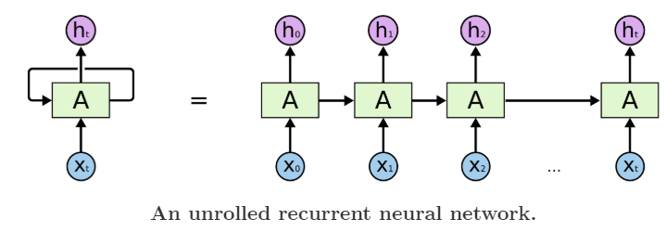
上图,是一个简单的 RNN 单元。RNN循环往复地把前一步的计算结果作为条件,放进当前的输入中。
适合在任意长度的序列中对上下文依赖性进行建模。但是有个问题,那就是我们需要提前把输入和输出序列对齐,而且目前尚不清楚如何将 RNN 应用在不同长度有复杂非单一关系的序列中。为了解决对齐问题,作者提出了一个理论上可行的办法:使用两个 RNN。 一个 RNN 把输入映射为一个固定长度的向量,另一个 RNN 从这个向量中预测输出序列。
为什么说是理论可行的呢?作者 Sutskever 的博士论文TRAINING RECURRENT NEURAL NETWORKS (训练循环神经网络)提出训练 RNN 是很困难的。因为由于 RNN 自身的网络结构,其当前时刻的输出需要考虑前面所有时刻的输入,那么在使用反向传播训练时,一旦输入的序列很长,就极易出现梯度消失( Gradients Vanish )问题。为了解决 RNN 难训练问题,作者使用 LSTM ( Long Short-Term Memory,长短期记忆)网络。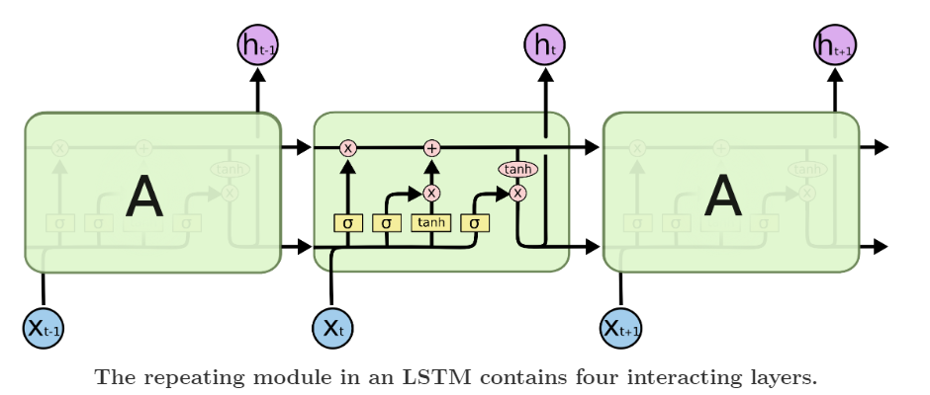
上图,是一个 LSTM 单元内部结构。LSTM 提出就是为了解决 RNN 梯度消失问题,其创新性的加入了遗忘门,让 LSTM 可以选择遗忘前面输入无关序列,不用考虑全部输入序列。经过 3 次尝试,最终加入 LSTM 后,一个简单的 Seq2Seq 模型就建立了。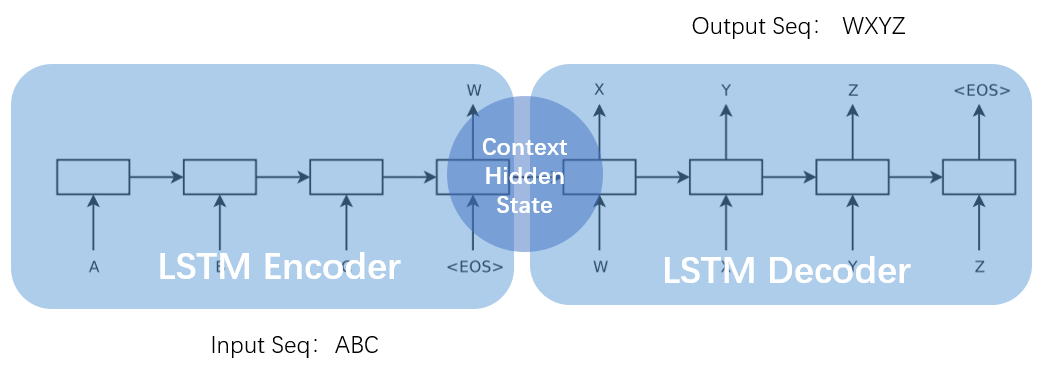
上图,一个简单的 Seq2Seq 模型包括 3 个部分,Encoder-LSTM,Decoder-LSTM,Context。输入序列是 ABC,Encoder-LSTM 将处理输入序列并在最后一个神经元返回整个输入序列的隐藏状态( hidden state ),也被称为上下文( Context,C )。然后Decoder-LSTM 根据隐藏状态,一步一步的预测目标序列的下一个字符。最终输出序列 wxyz。值得一提的是作者Sutskever 根据其特定的任务具体设计特定的 Seq2Seq 模型。并对输入序列作逆序处理,使模型能处理长句子,也提高了准确率。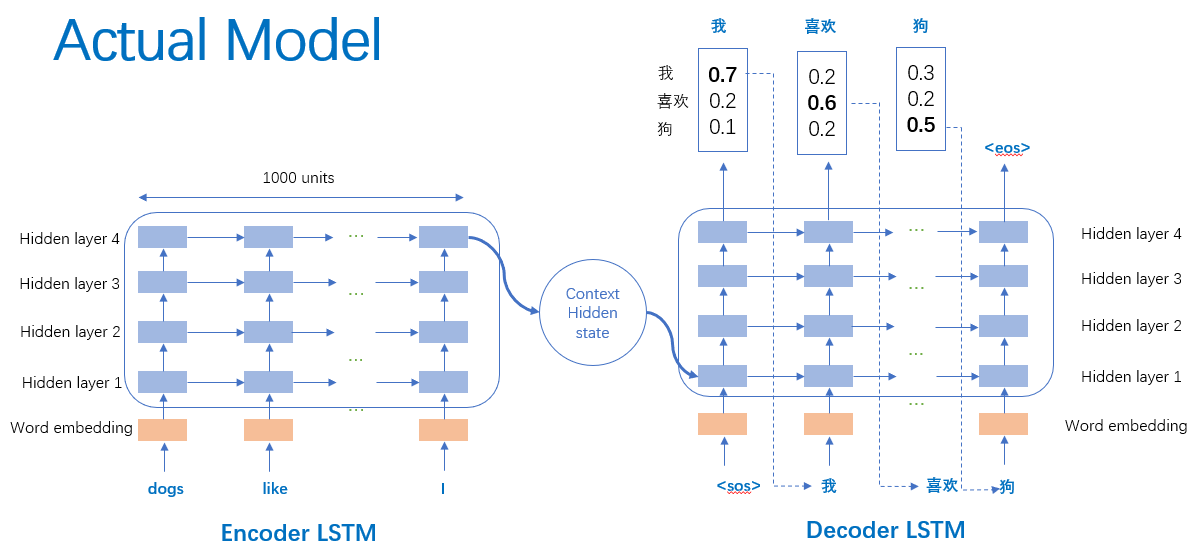
上图,是作者Sutskever 设计的真实模型,并引以为傲一下三点。第一使用了两个 LSTM,一个用于编码,一个用于解码。这也是作者探索并论证的结果。第二使用了深层的 LSTM ( 4 层),相比于浅层的网络,每加一层模型困难程度就降低 10% 。第三对输入序列使用了逆序操作,提高了 LSTM 处理长序列能力。
3. 中英文翻译
到了我们动手的时刻了,理解了上面 Seq2Seq 模型,让我们搭建一个简单的中英文翻译模型。
3.1 数据集
我们使用 manythings 站的一个中英文数据集,现已经上传到 Mo 平台了,点击查看。该数据集格式为英文+tab+中文。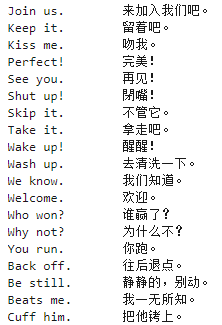
3.2 处理数据
from keras.models import Model from keras.layers import Input, LSTM, Dense import numpy as np batch_size = 64 # Batch size for training. epochs = 100 # Number of epochs to train for. latent_dim = 256 # Latent dimensionality of the encoding space. num_samples = 10000 # Number of samples to train on. # Path to the data txt file on disk. data_path = 'cmn.txt' # Vectorize the data. input_texts = [] target_texts = [] input_characters = set() target_characters = set() with open(data_path, 'r', encoding='utf-8') as f: lines = f.read().split('\n') for line in lines[: min(num_samples, len(lines) - 1)]: input_text, target_text = line.split('\t') # We use "tab" as the "start sequence" character # for the targets, and "\n" as "end sequence" character. target_text = '\t' + target_text + '\n' input_texts.append(input_text) target_texts.append(target_text) for char in input_text: if char not in input_characters: input_characters.add(char) for char in target_text: if char not in target_characters: target_characters.add(char) input_characters = sorted(list(input_characters)) target_characters = sorted(list(target_characters)) num_encoder_tokens = len(input_characters) num_decoder_tokens = len(target_characters) max_encoder_seq_length = max([len(txt) for txt in input_texts]) max_decoder_seq_length = max([len(txt) for txt in target_texts]) print('Number of samples:', len(input_texts)) print('Number of unique input tokens:', num_encoder_tokens) print('Number of unique output tokens:', num_decoder_tokens) print('Max sequence length for inputs:', max_encoder_seq_length) print('Max sequence length for outputs:', max_decoder_seq_length) 3.3 Encoder-LSTM
# mapping token to index,easily to vectors input_token_index = dict([(char, i) for i, char in enumerate(input_characters)]) target_token_index = dict([(char, i) for i, char in enumerate(target_characters)]) # np.zeros(shape, dtype, order) # shape is an tuple, in here 3D encoder_input_data = np.zeros( (len(input_texts), max_encoder_seq_length, num_encoder_tokens), dtype='float32') decoder_input_data = np.zeros( (len(input_texts), max_decoder_seq_length, num_decoder_tokens), dtype='float32') decoder_target_data = np.zeros( (len(input_texts), max_decoder_seq_length, num_decoder_tokens), dtype='float32') # input_texts contain all english sentences # output_texts contain all chinese sentences # zip('ABC','xyz') ==> Ax By Cz, looks like that # the aim is: vectorilize text, 3D for i, (input_text, target_text) in enumerate(zip(input_texts, target_texts)): for t, char in enumerate(input_text): # 3D vector only z-index has char its value equals 1.0 encoder_input_data[i, t, input_token_index[char]] = 1. for t, char in enumerate(target_text): # decoder_target_data is ahead of decoder_input_data by one timestep decoder_input_data[i, t, target_token_index[char]] = 1. if t > 0: # decoder_target_data will be ahead by one timestep # and will not include the start character. # igone t=0 and start t=1, means decoder_target_data[i, t - 1, target_token_index[char]] = 1. 3.4 Context ( hidden state )
# Define an input sequence and process it. # input prodocts keras tensor, to fit keras model! # 1x73 vector # encoder_inputs is a 1x73 tensor! encoder_inputs = Input(shape=(None, num_encoder_tokens)) # units=256, return the last state in addition to the output encoder_lstm = LSTM((latent_dim), return_state=True) # LSTM(tensor) return output, state-history, state-current encoder_outputs, state_h, state_c = encoder_lstm(encoder_inputs) # We discard `encoder_outputs` and only keep the states. encoder_states = [state_h, state_c] 3.5 Decoder-LSTM
# Set up the decoder, using `encoder_states` as initial state. decoder_inputs = Input(shape=(None, num_decoder_tokens)) # We set up our decoder to return full output sequences, # and to return internal states as well. We don't use the # return states in the training model, but we will use them in inference. decoder_lstm = LSTM((latent_dim), return_sequences=True, return_state=True) # obtain output decoder_outputs, _, _ = decoder_lstm(decoder_inputs,initial_state=encoder_states) # dense 2580x1 units full connented layer decoder_dense = Dense(num_decoder_tokens, activation='softmax') # why let decoder_outputs go through dense ? decoder_outputs = decoder_dense(decoder_outputs) # Define the model that will turn, groups layers into an object # with training and inference features # `encoder_input_data` & `decoder_input_data` into `decoder_target_data` # model(input, output) model = Model([encoder_inputs, decoder_inputs], decoder_outputs) # Run training # compile -> configure model for training model.compile(optimizer='rmsprop', loss='categorical_crossentropy') # model optimizsm model.fit([encoder_input_data, decoder_input_data], decoder_target_data, batch_size=batch_size, epochs=epochs, validation_split=0.2) # Save model model.save('seq2seq.h5') 3.6 解码序列
# Define sampling models encoder_model = Model(encoder_inputs, encoder_states) decoder_state_input_h = Input(shape=(latent_dim,)) decoder_state_input_c = Input(shape=(latent_dim,)) decoder_states_inputs = [decoder_state_input_h, decoder_state_input_c] decoder_outputs, state_h, state_c = decoder_lstm(decoder_inputs, initial_state=decoder_states_inputs) decoder_states = [state_h, state_c] decoder_outputs = decoder_dense(decoder_outputs) decoder_model = Model( [decoder_inputs] + decoder_states_inputs, [decoder_outputs] + decoder_states) # Reverse-lookup token index to decode sequences back to # something readable. reverse_input_char_index = dict( (i, char) for char, i in input_token_index.items()) reverse_target_char_index = dict( (i, char) for char, i in target_token_index.items()) def decode_sequence(input_seq): # Encode the input as state vectors. states_value = encoder_model.predict(input_seq) # Generate empty target sequence of length 1. target_seq = np.zeros((1, 1, num_decoder_tokens)) # Populate the first character of target sequence with the start character. target_seq[0, 0, target_token_index['\t']] = 1. # this target_seq you can treat as initial state # Sampling loop for a batch of sequences # (to simplify, here we assume a batch of size 1). stop_cOndition= False decoded_sentence = '' while not stop_condition: output_tokens, h, c = decoder_model.predict([target_seq] + states_value) # Sample a token # argmax: Returns the indices of the maximum values along an axis # just like find the most possible char sampled_token_index = np.argmax(output_tokens[0, -1, :]) # find char using index sampled_char = reverse_target_char_index[sampled_token_index] # and append sentence decoded_sentence += sampled_char # Exit condition: either hit max length # or find stop character. if (sampled_char == '\n' or len(decoded_sentence) > max_decoder_seq_length): stop_cOndition= True # Update the target sequence (of length 1). # append then ? # creating another new target_seq # and this time assume sampled_token_index to 1.0 target_seq = np.zeros((1, 1, num_decoder_tokens)) target_seq[0, 0, sampled_token_index] = 1. # Update states # update states, frome the front parts states_value = [h, c] return decoded_sentence 3.7 预测
for seq_index in range(100,200): # Take one sequence (part of the training set) # for trying out decoding. input_seq = encoder_input_data[seq_index: seq_index + 1] decoded_sentence = decode_sequence(input_seq) print('Input sentence:', input_texts[seq_index]) print('Decoded sentence:', decoded_sentence) 该项目已公开在 Mo 平台上,Seq2Seq 之中英文翻译,建议使用 GPU 训练。
介绍 Mo 平台一个非常贴心实用的功能:API Doc,(在开发界面的右侧栏,第二个)。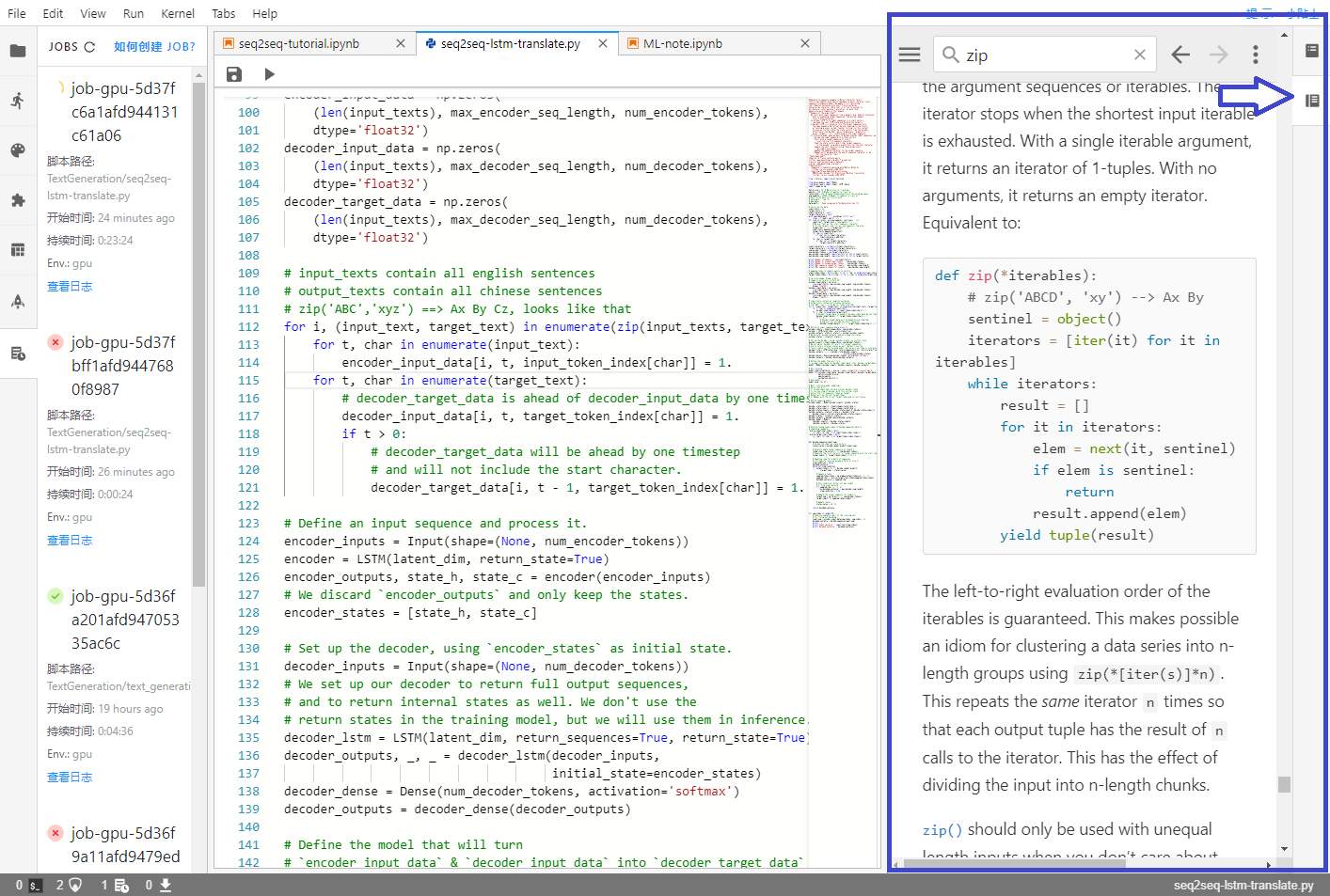
在 Mo 平台写代码可以很方便的实现多窗口显示,只要拖动窗口的标题栏就可实现分栏。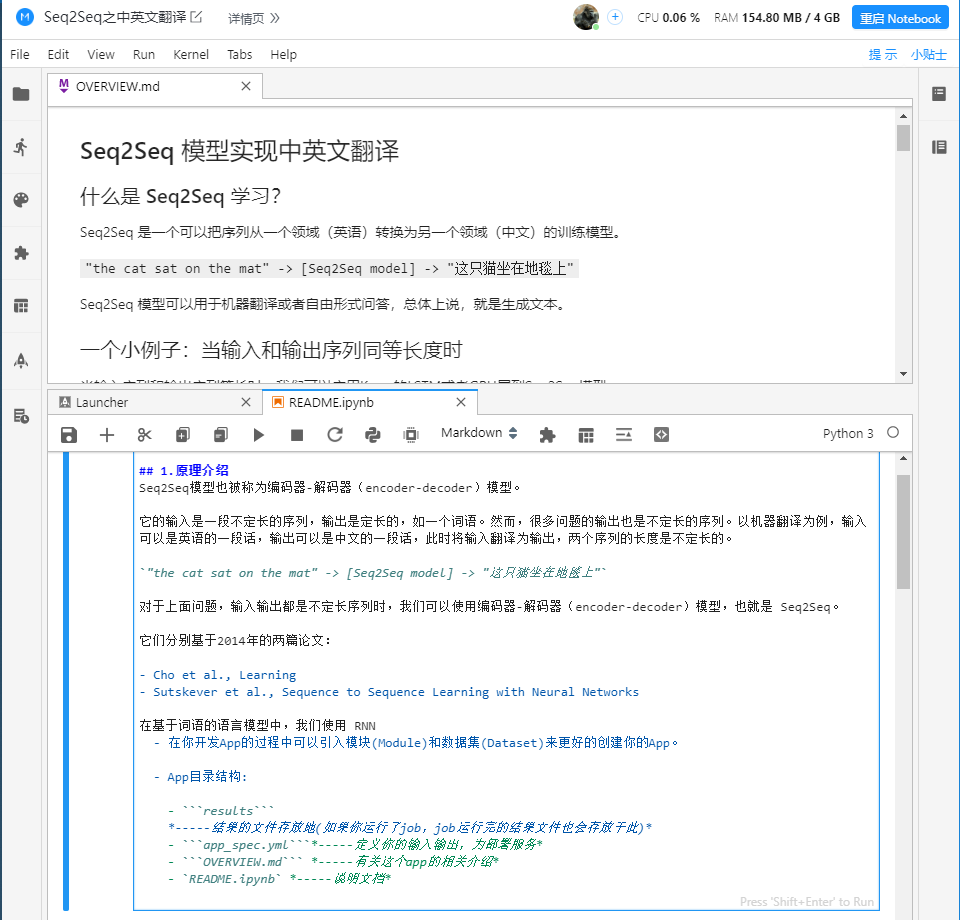
4. 总结与展望
提出经典的 Seq2Seq 模型是一件了不起的事情,该模型在机器翻译和语音识别等领域中解决了很多重要问题和 NLP 无法解决的难题。也是深度学习应用于 NLP 一件里程碑的事件。后续,又基于该模型提出了很多改进和优化,如 Attention 机制等。相信在不远的未来,会有崭新的重大发现,让我们拭目以待。
项目源码地址(欢迎电脑端打开进行 fork ):https://momodel.cn/explore/5d38500a1afd94479891643a?type=app
5. 引用
论文:Sequence to Sequence Learning with Neural Networks
博客:Understanding LSTM Networks
代码:A ten-minute introduction to sequence-to-sequence learning in Keras
 | 1 zhiiker 2019 年 8 月 4 日 给个邀请码? |
| 2 zhiiker 2019 年 8 月 4 日 momodel.cn 挂了,体验了下服务不错,但也要稳定一些吧 |
 | 3 MoModel OP @zhiiker https://momodel.cn/user/register?invitedBy=CL6Y2W 昨晚应该在部署,现在可以正常使用的,用上方链接注册可以得 3 小时 GPU 邀请码会自动填写的 |
 Select Language